
Bernard Hughes – Composer in Association
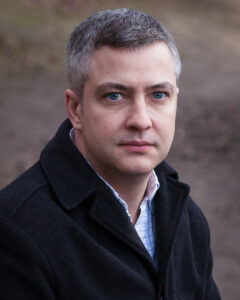
Trinity Boys Choir is thrilled to announce Bernard Hughes as our new Composer in Association. Bernard is one of the most distinctive and accomplished composers currently writing for choirs and voices, and we’re very excited to work closely with him in producing an exciting new work that will add to the range of works written for young voices.
Director of Trinity Boys Choir, Nicholas Mulroy, said:
“I’m so delighted that Bernard is coming on board to collaborate with us. He is a brilliant composer, whose music is imaginative, lyrical, sympathetic to sing, and enjoyable to listen to. I’m particularly excited that he’s agreed to write a piece for performance in September 2027 for girls’ and boys’ voices that will celebrate the arrival of girls at Trinity, and the inauguration of the younger cohort of Trinity Girls Choir. Welcome, Bernard!”
We sat down with Bernard to learn a bit about his musical life and his inspirations.
- Can you tell us a bit about how you became interested in composing? What were your formative musical experiences?
I started writing music down at about the age of 7, on scraps of manuscript paper lying round the house. No one suggested it, so it must have been an instinct. As a teenager I wrote the music for a school production of A Midsummer Night’s Dream, and that was something of a breakthrough in terms of it being quite good. Lots of people compose as teenagers—for GCSE Music or whatever—but where most people at some point stop, I’ve just never stopped. - Who would you say are your main influences? Which composers do you love? And which do you not?
My favourite composer has been Stravinsky since I was about 17—I fell in love with The Rite of Spring the first time I heard it. In recent years I’ve become more and more of a fan of Vaughan Williams; there are so many brilliant pieces. I’ve also always loved Bach, and my favourite piece of pre-20th century music is Schubert’s brilliant Fifth Symphony.I didn’t really start writing choral music until I was nearly 30, but contemporary choral pieces that have influenced me include Joby Talbot’s Path of Miracles, Judith Weir’s Missa del Cid, and Thomas Jennefelt’s Villarosa Sequences. - Can you say something about writing for voices in general, and for young voices in particular? You’re particularly sensitive to text and astute with your choice of text—can you reveal your secrets?
I am not a singer by background or training and am always in awe of what singers can do. I think my lack of experience as a singer makes me careful about what I write, but I’m also not cramped by a knowledge of lots of choral repertoire.I love finding texts to set—it’s a bit of a curse to always be reading poetry with half an eye to whether it would be settable—and I usually trust my initial gut feeling about whether something will work. I like texts that are metrical, or at least have something rhythmic about them, although I often use irregular rhythms and changing time signatures to try to capture the speech rhythm of the words.In recent years I have worked extensively with the writer Helen Eastman, who is not only a brilliant poet, but can also do things like retro-fit words to music I’ve already written or edit text if the music demands it. This is not something you can do with dead writers! - Are there any works you’re particularly proud of? Do you have a favourite performance memory?
I always regard a piece as a solution to a particular problem or an answer to a question, so the most successful pieces are usually the ones that best meet the brief.I wrote a piece for the Proms in 2021 for the BBC Singers, which had quite a specific brief, and I was delighted when the artistic director told me I had done “everything he asked for and more”. Being in the Royal Albert Hall for that performance was a career highlight.I am proud of my big radio opera on a Norse myth, The Death of Balder, but also of smaller pieces like Perhaps (recently recorded by TBC), which someone described as “like the tune had always existed but you just wrote it down”, which was a lovely thing to hear. - Tell us about yourself when you’re not composing. Favourite place in the world? Ideal day? Dream meal? Your idea of happiness?
Outside music I am a cricket obsessive, both as a watcher and a player. I play for the same club I joined when I was 15.I am also a committed reader, finishing about 75 books a year and normally having four or five on the go at any time. My favourite place in the world is probably my little garden, wonderfully maintained by my wife, where I can sit and read.I also love listening to music. Lots of musicians can get jaded about music, but I have retained my love for it, from the classical composers I’ve mentioned to geniuses like Stevie Wonder, Björk and The Divine Comedy.I have two cats, who are old and thick, but whom I adore completely. Perhaps my happiest times are getting up early before everyone else and sitting with my cats, drinking tea with some music playing.
I am really excited about this new collaboration with Trinity School and can’t wait to get started. I have spent my professional life in girls’ schools, so have lots of experience writing for girls’ voices. I’m looking forward to the school going co-educational and helping to bring the girls fully into the musical life of the school. And of course to write for the Trinity Boys Choir, with their versatility and quality—the possibilities feel endless at the moment.